
Off-the-shelf package or custom software?
Not every business needs custom software. The decision depends on how specific your process is, how many systems it has to talk to and how long you plan to use the software. If you are a small business that mainly wants to "get out of Excel", start with the comparison on the getting a business program built page.
- Custom software makes sense: when your production, ordering, dealer or field process differs from the industry standard and that difference is what makes your business valuable.
- Custom software makes sense: when teams type the same data into several programs by hand and errors come from that re-entry.
- Custom software makes sense: when licence, user or module limits of a packaged product hold back your growth.
- Off-the-shelf is better: for general accounting, payroll and statutory tax filings, where regulations change often and the process is the same for everyone.
- Off-the-shelf is better: when the need is short-term or not yet clear; trying the process with a ready-made tool first and moving to custom software later is less risky.
The right answer is often a combination: accounting and e-invoicing stay in a packaged product, your company-specific operations run in custom software, and the two talk to each other through an integration.
Source code and data ownership
The first thing to settle in the contract for bespoke software is ownership. Having the source code, database and server access handed over to you means you are never locked in if you want to work with another team later.
- The current source code is kept in a version control repository (e.g. Git) under an account you own.
- Domain, server, App Store and Google Play developer accounts are registered in your company's name.
- Database backups are taken regularly and restores are actually tested.
- A list of the third-party libraries and services used is part of the handover documentation.
If you have a system that another company started and left unfinished, the taking over an unfinished software project process begins with a report on the state of the existing code.
Integration with your existing systems
The value of custom enterprise software usually comes less from what it does on its own than from how it connects to your other systems. Typical integration points are:
- ERP and accounting: two-way sync of customer accounts, stock, prices and orders; if you run SAP, see the SAP integration page.
- E-invoicing / e-archive: creating documents and tracking their status through the e-invoicing provider's API.
- Shipping: creating shipments and retrieving labels and tracking numbers.
- Payments: payment gateway, 3D Secure and instalment flows.
- Reporting: scheduled data feeds into a management dashboard or BI tool.
For overall connection design and choosing services, the API integration page goes into more detail.
Discovery, MVP and iterative releases
- Discovery: interviews with process owners and a review of current screens, Excel files and documents; scope and priorities are put in writing.
- Scope and design: the data model, user roles and drafts of the main screens are submitted for approval.
- MVP: the process that creates the most value ships first as a version real users can try.
- Releases: new modules are added in short release cycles based on feedback; every release is tested in a staging environment before going live.
- Handover and training: user training, an administrator guide and technical documentation are delivered.
Instead of one big, all-at-once delivery, this approach keeps your business running on working software at every stage. For the technical details of web application and SaaS architecture, see the web application development page.
Maintenance, security and data protection
Maintaining live software covers bug fixes, server and library updates, backup checks and small enhancements. The scope of maintenance and how support is handled are agreed in writing from the start.
- Role-based access control; every user sees only the data their job requires.
- Secure password storage, HTTPS and session security.
- Planning privacy notices, retention periods and access logs for personal data under KVKK (Turkey's data protection law) and, where applicable, GDPR.
- An audit trail (who changed what, and when) for critical operations.
What I offer
Decision framework
Weighing off-the-shelf and custom together
You own the code
Code, data and accounts in your name
ERP integration
Links to SAP, accounting and stock systems
E-invoicing and shipping
Provider and carrier API connections
Start with an MVP
First working release, then modules
Maintenance and docs
Updates, backups and technical docs
Technologies I use
Example projects
A selection of live projects serving real users.
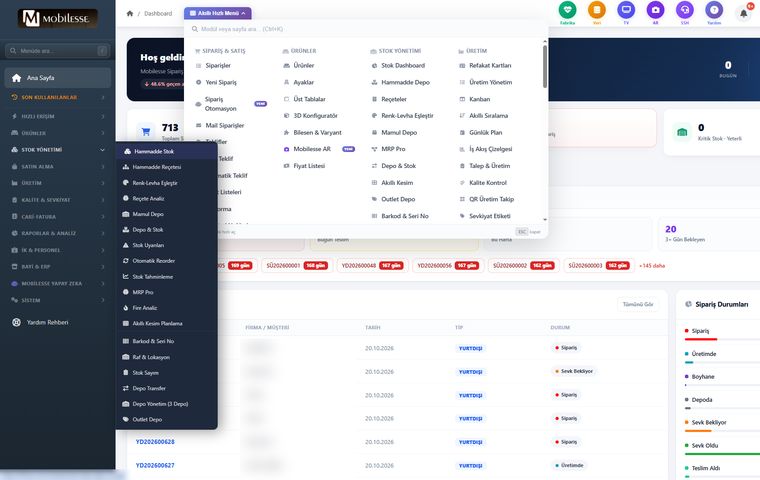
Mobilesse Mobilya — Furniture Manufacturing ERP
One-platform ERP from order to production, stock to shipment and e-invoice for a furniture manufacturer in Inegol, including a 3D product configurator.
ViewMandalin Pharmaceutical Warehouse Automation B2B
B2B ordering portal for pharmacies, multi-warehouse/branch stock, transfers, e-invoicing and reports.
ViewPDKS — Staff Attendance Tracking
Multi-tenant attendance SaaS in 4 languages.
ViewHow we work
Free intro call
We clarify needs, existing systems and goals together.
Quote & roadmap
Scope, technology, timeline and budget within 24 hours.
Staged development
Weekly demos and a live test environment.
Launch & support
Go-live, training and ongoing maintenance.
Free pre-analysisThe first meeting and roadmap are completely free, with no obligation.
Staged delivery and approvalYou review each module on a test environment before we move on.
Written scope and rightsScope, delivery and source code rights are defined in the contract.
Frequently asked questions
What is custom software development?
Custom software is software designed and built around your company's own business processes instead of a packaged product. Screens, permissions, reports and integrations are built to match how you work, and the source code is handed over to you.
Does every company need custom software?
No. For areas that work the same for everyone, such as general accounting or payroll, an off-the-shelf package is usually the better fit. Custom software makes sense when your process is non-standard, when several systems need to work in one flow, or when a packaged product limits your growth.
Who owns the source code?
The contract states that the source code, database, server and app store accounts belong to your company. The current code is kept in a repository you own, so you can also work with another team in the future.
Will custom software work with my existing ERP or accounting system?
Yes, as long as your system offers an API, a web service or a data export method. Customer accounts, stock, prices and orders can be synced in both directions, and e-invoicing, shipping and payment systems are connected the same way.
How does the development process work?
Scope is defined in discovery sessions, the data model and screen drafts are approved, and then a first version (MVP) ships that real users can try. Further modules are added in short release cycles, and every release is tested in a staging environment first.
How is the price determined?
The price depends on scope, number of integrations, user roles and platforms. After the discovery call you receive the scope as a written quote.