
What problem does it solve?
At most small and medium-sized manufacturers, quality control still relies on the operator's eye. Attention drops toward the end of a shift, and defects such as scratches, missing parts, wrong labels or color differences can reach the customer. Industrial machine vision systems require special cameras, lighting, an integrator and a long installation, so they are often out of reach for these businesses. On top of that, nobody records which defect is increasing on which shift or which machine, so the root cause of the problem cannot be found. Because line efficiency is not measured, downtime and speed losses also stay invisible.
Target customers
- SMEs producing plastic, metal and packaging
- Food and beverage filling lines
- Textile and apparel workshops
- Automotive parts suppliers
- Quality assurance consultants and system integrators
How the product works
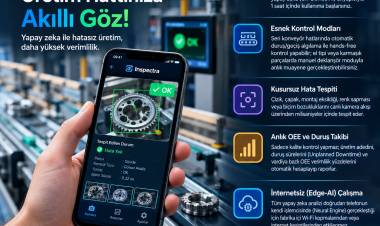
An iPhone or tablet mounted on the line captures images as each product passes. An on-device AI model classifies every product as good or defective and flags defective ones on screen and with an audible alert. The business trains the model for its own product by capturing its own defective and good samples; inspection continues even if the internet connection drops. OEE is calculated from the counted products, defects and downtime data, and reported on a web panel by shift, machine and product. Managers can review which defect type is increasing, together with image evidence.
What the first version (MVP) needs
- On-device defect detection: Good/defective classification from the camera image
- Model training flow: Labeling and training with the business's own sample photos
- Instant alerts: Screen, sound and vibration notification for defective products
- Defect gallery: Image evidence and timestamp for every defective product
- OEE calculation: Availability, performance and quality components
- Shift and machine report: Breakdown of defect types and downtime
- Web admin panel: Monitoring multiple lines and devices from a single screen
- Offline operation: Data sync once the connection is back
Revenue model
- Monthly/annual subscription per line or device
- Service fee for setup, lighting layout and model training
- Additional model development for custom defect types
- Reseller licenses for integrators and quality consultants
Why now?
Processing power and camera quality in mobile devices have made image processing that once required dedicated hardware feasible on the device itself. In Turkey, exporting SME manufacturers have to document defect records because of their European customers' quality and traceability expectations. There is a gap for a low-setup-cost, subscription-based solution for businesses that cannot invest in expensive systems. Small manufacturers in Europe have the same need.
A faster start on a ready platform
Hakan's Inspectra app already performs visual quality control and OEE tracking on the production line with an iPhone camera and on-device AI. Starting from this core shortens the time needed to develop the model and app from scratch.
End-to-end roadmap
- Validate the idea (1 week): Interviews with target customers, competitor and pricing research; we sharpen the idea together in a free pre-analysis.
- Scope and design (1–2 weeks): MVP feature list, screen designs and technical architecture; written scope and quote.
- Build the MVP (6–10 weeks): Staged development with weekly demos and a test environment; the source code belongs to you.
- Pilot (2–4 weeks): Real use with the first customers, feedback and fixes.
- Launch and grow (ongoing): App Store and Google Play release, website and SEO, payments and subscriptions, new modules.
Timelines are estimates; they are fixed in a written quote once the scope is clear.
Risks and how to handle them
- Accuracy drops when ambient light changes: Define a standard for fixed lighting and camera position during setup
- Every business's product is different: Put a fast model training flow using the customer's own samples at the center of the product
- Customers may trust the results completely and stop checking: Position the system as an assistant to the operator and recommend continued sample inspection for critical products
Technologies
Frequently asked questions
Does camera-based quality control require special hardware?
In most scenarios an iPhone or tablet, a fixed mount and proper lighting are enough. Very small defects or high-speed lines may require an additional lens or an industrial camera.
Is the AI model trained separately for each product?
Yes, training is done for each product and defect type using the business's own good and defective samples. The in-app labeling flow lets staff do this without technical knowledge.
How is OEE tracking calculated?
The camera counts products passing by and records downtime and defective products. From this data, the availability, performance and quality components are calculated to produce the OEE report.
Does it work without internet?
Because detection runs on the device, the line keeps working without internet. Data is transferred to the web panel once a connection is available.