
What problem does it solve?
In vocational high schools and training institutions, students often cannot practice with real equipment: devices are expensive, few in number, and misuse carries risk. Existing foreign simulators come with high license costs, are tied to a fixed lab, and their interfaces are not in Turkish. As a result, most students in a class spend the lesson watching, and time for hands-on practice stays limited. Instructors also lack a tool to measure at which step a student is struggling.
Target customers
- Maritime vocational high schools and faculties
- Vocational and technical Anatolian high schools
- Vocational colleges
- Private course and certification centers
- Industrial and logistics companies training their own staff
How the product works
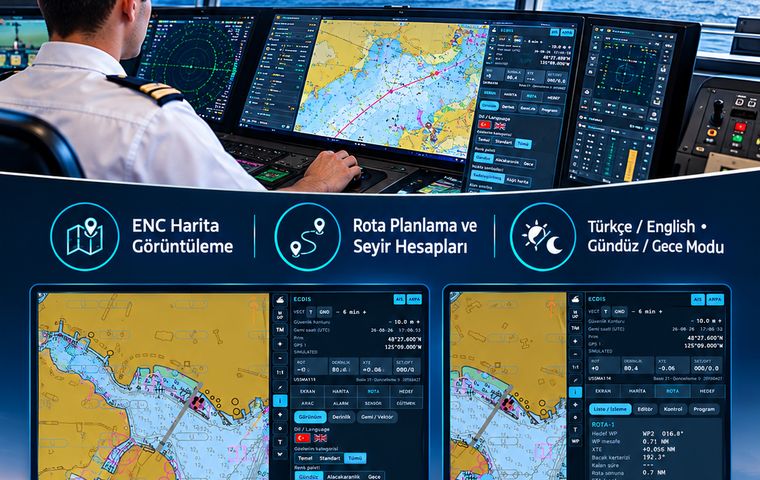
The simulator recreates the real equipment's screen, menus and workflow on an Android tablet. In the maritime example, students plan routes on an electronic nautical chart, perform navigation calculations and make decisions in scenarios. Instructors assign scenarios from the instructor panel, student steps are recorded and an assessment report is produced. The same architecture can be adapted to other vocational fields, such as electrical panel wiring, CNC machine control panels or lab instruments, by changing the interface and scenario library. The app also works without internet.
What the first version (MVP) needs
- Equipment interface: tablet version of the real device's screen and menu flow
- Scenario library: step-by-step tasks aligned with the curriculum
- Instructor panel: class, student and scenario assignment
- Performance logging: recording students' steps, times and errors
- Assessment report: output by student and class
- Offline operation: use in the lab without internet
- Multilingual interface: Turkish and English
Revenue model
- Annual license per school or institution
- Turnkey classroom package with tablets, cases and charging unit
- Fees for developing new vocational fields or custom scenarios
- Instructor training and technical support packages
Why now?
The importance placed on hands-on learning in vocational education is growing, but school budgets cannot cover expensive foreign simulators. The spread of tablets makes it possible for every student to practice on their own device. A Turkish interface and local support are an important reason for institutions to choose a product, both for ease of use and for continuity of maintenance. The same product can also be offered to training institutions in nearby regions with a non-Turkish interface.
A faster start on a ready platform
Hakan's NSİ ECDIS app is ready as a local Turkish/English training simulator for maritime high schools and faculties, running on an Android tablet with ENC charts, route planning and navigation calculations. In maritime education you can start directly from this product, and in other fields from the same tablet simulator architecture.
End-to-end roadmap
- Validate the idea (1 week): Interviews with target customers, competitor and pricing research; we sharpen the idea together in a free pre-analysis.
- Scope and design (1–2 weeks): MVP feature list, screen designs and technical architecture; written scope and quote.
- Build the MVP (10–16 weeks): Staged development with weekly demos and a test environment; the source code belongs to you.
- Pilot (2–4 weeks): Real use with the first customers, feedback and fixes.
- Launch and grow (ongoing): App Store and Google Play release, website and SEO, payments and subscriptions, new modules.
Timelines are estimates; they are fixed in a written quote once the scope is clear.
Risks and how to handle them
- Long procurement process: run a free pilot with a school to build a reference, and learn the institution's purchasing calendar in advance
- Fidelity to real equipment: prepare scenarios together with subject-matter expert instructors, and state clearly that the simulator does not replace official certification training
- Student data: obtain parent and institution consent under KVKK (Turkish data protection law) for the data of minor students, and offer the option to keep data on the institution's server or on the device
Technologies
Frequently asked questions
Can a tablet simulator replace a real simulator?
It does not replace a full mission simulator, but it lets students learn the interface, menus and workflow. This way, expensive lab hours are used more efficiently.
Which fields besides maritime can it be adapted to?
It can be adapted to screen- and procedure-heavy fields such as electrical-electronics, machinery and CNC, automotive, laboratory and health technician training by changing the interface and scenario library.
How do schools purchase this product?
Public schools usually buy through direct procurement or tenders, while private institutions buy through a direct contract. A pilot and a reference school speed up the sales process.
Is an internet connection required?
No. The simulator runs offline on the tablet; data is transferred to the instructor panel when a connection is available.